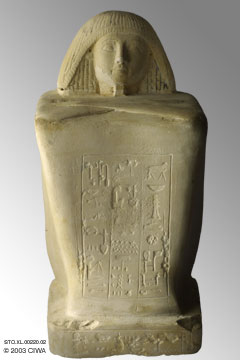
| Period: | | Egypt, Late Period, Dynasty 30 |
| Dating: | | 380 BC–343 BC |
| Origin: | | Egypt, Lower Egypt, Mendes |
| Material: | | Limestone |
| Physical: | | 31.4cm. (12.3 in.) - 13250 g. (467.7 oz.) |
| Catalog: | | STO.XL.00220 |
Links to other views:
⇒ Larger View
⇒ Face and hands (detail)
⇒ Hand and seal (detail)
if scripting is off, click the ⇒ instead.
• • •
Links to others from Dynasty 30
Shawabti of Herefer-Neith, Dyn. 30
Shawabti of King Djed-Hor (Teos), Dyn. 30
Shawabti of Prince Pa-Khaas, Dyn. 30
Shawabti of Prince Pa-Khaas, Dyn. 30
Shawabti of Prince Pa-Khaas, Dyn. 30
Shawabti of Prince Pa-Khaas, Dyn. 30
Shawabti of Wahibramaket, Dyn. 30
Links to others of type Statuette-man
Bacchus the child, Roman, 100 BC-200 AD
Bes in terra-cotta, Dyn. 27
Bronze athlete, Rome, 96-192 AD
Bronze Etruscan warrior, Etruria, 480 BC
Bronze Herakles, Etruria, 500 BC
Bronze Imhotep seated, Dyn. 25 (?)
Bronze ithyphallic god Bes, Ptolemaic
Bronze of a king as Nefertem, N.K.
Bronze of a king as Orisiris, Dyn. 18-19
Bronze of a king as Osiris, Dyn. 18
Bronze of a king as Osiris, Dyn. 22
Bronze of a king as Osiris, Dyn. 26
Bronze of a king as Osiris, Dyn. 26
Bronze of King Psamtik I as Osiris, Dyn. 26
Bronze of King Psamtik I as Osiris, Dyn. 26
Bronze of King Sethi I as Nefertem, Dyn. 19
Bronze of King Shabaka ? as Osiris, Dyn. 25
Bronze of Ptah, Memphis, Dyn. 25
Bronze ritual pendant of Osiris, Dyn. 25
Bronze Samnite gladiator, Rome, 30 BC-68 AD
Bronze statuette of Anhur, Dyn. 20
Bronze statuette of Ptah, Dyn. 25
Bust of Zeus, Macedonian Dynasty
Disrobing ephebe, Roman World, 50-300 AD
Enameled feathers of Amun, Dyn. 18
Gilded wooden statuette. Early Dynastic
God Bes as a Roman soldier 30 BC-200 AD
Head, realistic portrait in stone, Dyn 18
Horus-the-Child, 1070-774 BC
Horus-the-Child, Alexandria, 100-30 BC
Horus-the-Child, Alexandria, 304-30 BC
Horus-the-Child as a ruling king, Dyn. 18
Horus-the-Child as Amun, 776-656 BC
Horus-the-Child, Dyn.19, 1300-1200 BC
Horus-the-Child, Dyn. 25, 776-656 BC
Horus-the-Child, heir to the king, Dyn. 26
Horus-the-Child, Ptolemaic, 200-100 BC
Horus-the-Child, Ptolemaic, 304-30 BC
Horus-the-Child riding a swan, 304-31 BC
Imhotep, vizier and architect of King Djoser
Ivory head of Emperor Constantine
King Ahmose II (?) as Osiris, Dynasty 26
King Amenemope (?) as Osiris, Dyn. 21
King Amenhotep II (?) as Amun-Re, Dyn. 18
King as Horus-the-Child, Dyn. 12
King Horemheb as Amun-Re, Dyn. 18
King Nekaw II as Horus-the-child, Dyn.26
Osiris, King of the Afterlife, Dyn. 18
Osiris, King of the Afterlife, Dyn. 22
Osiris of an unknown king, Dyn. 18 (?)
Osiris-Neper, god of agriculture, Dyn. 18
Osiris-Neper, god of agriculture, Dyn. 22
Osiris-Neper, god of agriculture, Dyn. 25
Porphyry statue of Alexander The Great
Pottery child head, Phoenicia, 1000-500 BC
Pottery silenus (satyr), Greece, 350-300 BC
Priest of Hapy, temple of Aswan, Dyn. 20
Ptah-Min of Memphis, Dyn. 20
Queen as Goddess Neith seated, Dyn. 25
Ruling king as Khonsu, Dyn. 20
Sept, local prince of Nubia, Dyn. 12-13
Statue pedestal of Osorkon II, Dyn. 22
Statuette of a privileged man, Dyn. 18
Stone bust of a scribe, Dyn. 18
Stone head of a king, Dyn. 12
Stone statue of King Thutmose III, Dyn. 18
Tall bronze Osiris, Ptolemaic Period
Unfinished stone statue, Dyn. 19
Wood statue of Amenemhat II, Dyn. 12
Wood statue of King Smenkhkare, Dyn. 18
|
|
This limestone cube statue portrays Nefer-Khaaw, revered noble, scribe of the treasury in Mendes, one of the greatest cities of the Delta in Lower Egypt, Dynasty 30.
The owner’s name and title are inscribed in front, at the base of the statue. From right to left, the hieroglyphs read: “The scribe of the treasury, the son Nefer-Khaaw, the noble.”
The recital is inscribed in three vertical registers, from right to left. The hieroglyphs read: “Apis, the master of Mendes, the living oxen god, the beget of Horus, offers water, breath and vessels of beer to the scribe of treasury, thy son, the beloved, Nfr-Khaaw, the revered noble, true of voice.”
“Mendes was a significant site not only in the Predynastic and Early Dynastic eras, but during most of the later transformational epochs of Egyptian antiquity as well. It was already a significant settlement during the initial formation of the Egyptian state in the late fourth millennium BC, and it increased in size and importance during the maturation of the Egyptian state in the Old and Middle Kingdoms. During the complex imperial dynamics of the New Kingdom and Late period it became one of the greatest Delta cities” (Bard 1999:500).
Bibliography (for this item)
Aubert, Jacques-F., and Liliane Aubert
1974 Statuettes égyptiennes: chaouabtis, ouchebtis. Librairie d’Amerique et d’ Orient, Paris, France.
Bard, Kathryn A., and Steven B. Shubert
1999 Encyclopedia of the Archeology of Ancient Egypt. Routledge, London, United Kingdom. (500)
Khalil, Hassan M.
1976 Preliminary Studies on the Sanusret Collection. Manuscript, Musée l’Egypte et le Monde Antique, Monaco-Ville, Monaco. ((I) 29-33)
Posener, Georges, Serge Sauneron, and Jean Yoyotte
1970 Dictionnaire de la civilisation Egyptienne. 2nd edition. Fernand Hazan, Paris, France. (262)
Ziegler, Christiane
1997 The Louvre: Egyptian Antiquities (Reprint of 1990 edition). Edition Scala, Paris, France. (69)
|
)
)
)
)